… and why the feedback we need most only flows where it’s safe to give.
You ski the slope, nothing happens, and you may learn the wrong lesson. Most of the feedback we get in avalanche terrain is silence, from the snow and from each other. This post is about what that silence may hide, and how groups can learn anyway.
Part 2 of 3 on ‘safety’ in avalanche terrain.
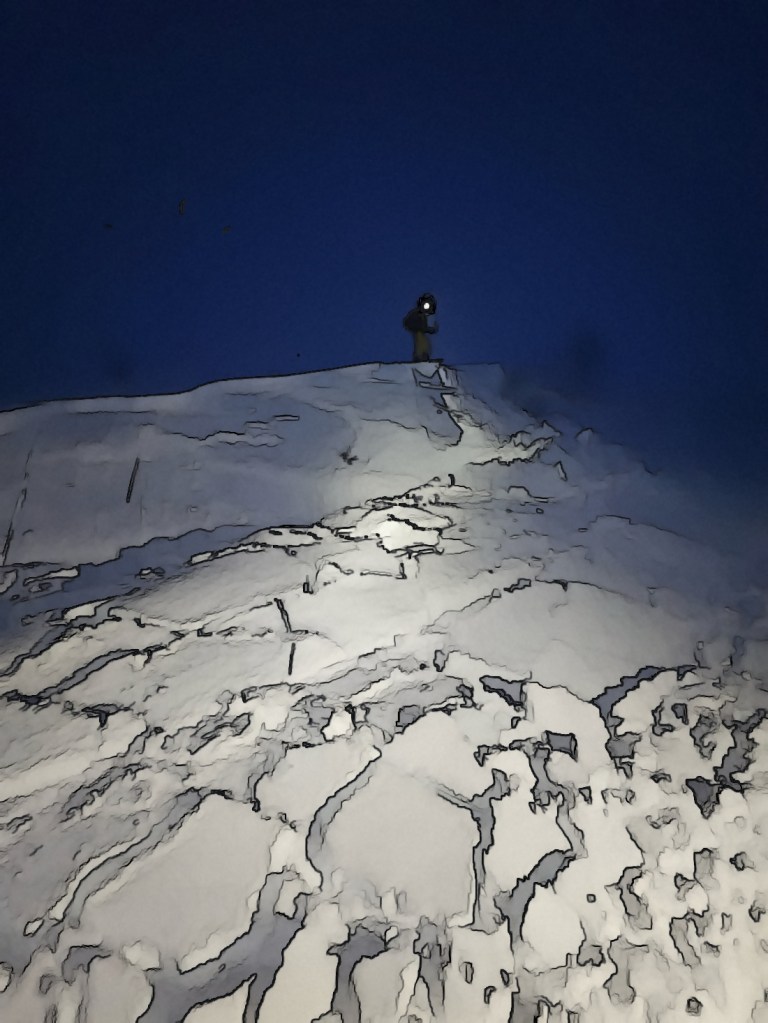
Most of the time, the mountain says nothing. Sometimes it answers loud and clear.
You ski the slope and nothing happens. Was that because you read the snow right, or because you got away with it? On the mountain, the two can feel exactly the same.
Now picture a touring partner who felt a whoomph on the way up and said nothing, because everyone else seemed so sure. The group skis the slope, nothing happens, and the day goes down as a good one. Only on the drive home does it come out: “Did anyone else feel that?” The snowpack taught the group nothing that day. The group may have taught itself something worse: that staying quiet works.
Learning is inevitable and not always to our advantage.
In this series I argue for a wider understanding of safety on the mountain. Safe from the avalanche, yes, but also safe to speak and safe to learn. This post zooms in on the last two, and on a problem the snow and the group seem to share.
A deep persistent weak layer in the group
Rachel Reimer and colleagues interviewed mountain guides and avalanche professionals from groups that rarely get heard in the profession: women, 2SLGBTQ+, BIPOC and survivors of workplace trauma (Reimer & Eriksen, 2025; Reimer, Eriksen & Warren, 2026). One of them compared navigating human-caused hazards, such as exclusion and harassment, to managing a deep persistent weak layer, the avalanche problem the Conceptual Model of Avalanche Hazard (CMAH) calls the most difficult to assess, predict and manage. This is a fitting metaphor.
The comparison isn’t new. In a recent paper (Skille, Dassler & Boilen, 2026) we argued that the avalanche community needs something akin to the CMAH for the human factor: a shared vocabulary for people, the way avalanche problems gave us one for snow. Building on 14 expert interviews and a workshop with 62 experts and practitioners at ISSW 2024, we proposed a typology of seven factors (perception, discipline, emotions, motivation, self-awareness, peer influence and competence) playing out across four interactional dimensions (social, intra-personal, cultural and environmental), all resting on three underlying principles that never go away: uncertainty, fallibility and communication.
When I read that story of the quiet day on the skin track through this lens it fits almost uncomfortably well. There’s conforming peer influence. Emotions and self-perceptions stay unexpressed. There’s also what the typology files under discipline: the courage to take on an inter-personal challenge. And underneath it all, communication. We even described the situation in the paper: group members may well recognize the warning signs, while social dynamics and their own inner hesitations keep them from saying so.
But two things stand out when reading Reimer next to our own typology. First, practitioners at the workshop asked us to drop the term ‘human problem’ and use neutral language instead, since the same factors that lead us astray also make for good decisions. Peer influence can push a group into a slope, or make it stop, reassess and change plans. Reimer, on the other hand, calls exclusion and harassment what they are: hazards. I think both can be right. Most human factors are neutral, but depending on the context some human behavior isn’t. Second, our typology has no box for power or identity. The cultural dimension and peer influence come closest, but nothing in it asks whose voice counts in the group. If we want a CMAH for the human factor, that blank spot may be the deep persistent weak layer in our own model.
Quiet snow isn’t stable snow, silent partners isn’t good communication
Ironically, we had already written the snow half of Reimer’s analogy ourselves. In a recent study of avalanche course participants (Dassler, Fjellaksel & Pfuhl, 2026), we marked down a participant who took the absence of whoomphs and shooting cracks as proof of a stable snowpack. With a deep persistent weak layer, we noted, those signs may simply never show up. Quiet snow isn’t necessarily stable snow. What we didn’t do was apply the same logic to the people standing on top of the slope: a silent person or a quiet group isn’t necessarily a group in agreement.
Both problems feed on non-event feedback. You ski the slope, nothing happens, and the stability you assumed feels confirmed. You tour with a group where nobody raises a concern, nothing happens, and the good communication and psychological safety you assumed feels confirmed, too. As one of Reimer’s participants put it, you can have an emotionally unsafe environment, still get home, and conclude you were fine, when you really just got away with it.
A different workshop we ran with 45 avalanche educators, practitioners and researchers at ISSW 2024 discussed the same wickedness from the teaching side (Fjellaksel et al., 2026): most poor decisions in avalanche terrain end in an uneventful, sometimes even exhilarating, descent. In other words, the snow-covered mountain is a poor teacher. Did we have a good decision-making process, or did we just get away with it? is a question worth asking about the snowpack. It’s just as worth asking about the group.
The human in the loop
If the mountain is a poor teacher, the feedback, we argue (Dassler & Dahl, 2026), has to come from somewhere else. A slope that doesn’t slide is information, not feedback. It only becomes feedback when someone helps you link it to your decision-making process, goal and to what you’ll do differently next time. Hattie and Timperley break this down into feed-up (what’s the goal?), feed-back (how am I doing?) and feed-forward (what should I do next?). At best, the mountain supplies the middle one. The other two need a human in the loop: a mentor, an instructor or a touring partner who’s willing to think out loud.
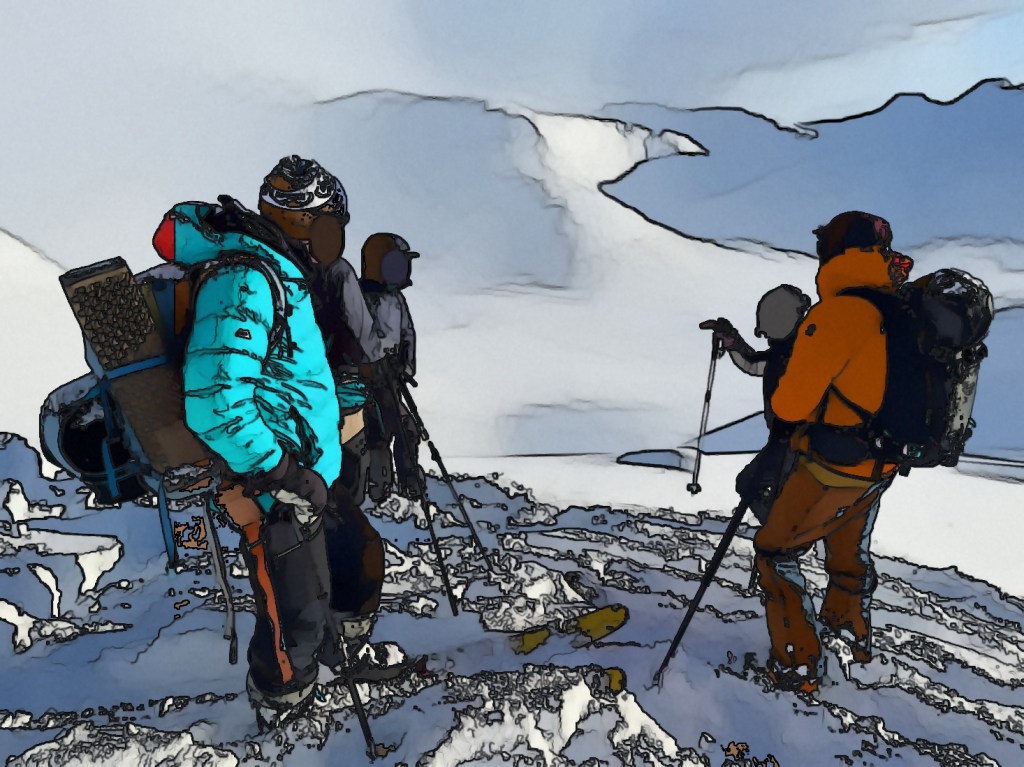
Who’s talking, who’s listening, and who’s still deciding whether to say something?
Which brings us straight to psychological safety. Thinking out loud means not only articulating assessments, but also voicing thoughts, doubts, half-formed hunches and I’m not sure. That’s exactly what our quiet touring partner didn’t feel able to do. Feed-forward only works in a group where it’s safe to speak and safe to learn. Put differently: the human in the loop is only as useful as the loop is safe.
When the mountain does answer back
Every now and then, the mountain does give clear feedback. Brutally clear, in fact. And even then, we often don’t hear it, because the people it happened to don’t feel safe enough to tell it. Avalanche involvements are thought to be heavily under-reported, and our colleague Tove Dahl’s new ISSW paper (Dahl, 2026) helps explain why. She interviewed three friends caught in the 2023 avalanche in the Godmother Couloir in Lyngen, two of them severely injured, about which stories they told afterwards, to whom and when.
For a long time, the answer was: not many. Silence turned out to be one of the story types in its own right, and all three said that most of the time, nothing was told at all. As Niels put it, on stage for the first time 32 months later: “In the start, we didn’t talk about it … because we felt shame.”
What helped them break that silence is worth paying attention to. First, they talked to a local friend and professional guide, who reassured them that making mistakes is human and happens to the best of us. Then the three of them wrote down their own memories and crafted what Dahl calls Our Story: a shared account of what happened, with errors acknowledged but without blame, in which they were still friends and still freeriders. Only after that did the stories open up: first to family and close friends, much later to the wider community, on stage, on a podcast and on TV.
The parallel between Dahl’s and Reimer’s findings is hard to miss. Stories are an important way of how a community learns from the rare times the mountain answers back. Learning theorists call them ‘packages of situated knowledge’. But whether they get told depends on psychological safety at the level of the whole community: will I be judged, or listened to? That comment on the drive home was a story, too. Just a small one, told late. Safe to speak, it turns out, also means safe to tell. Or, in Niels’ words: “How else should other people learn from our mistakes?”
What this means for your next tour
Debrief the good days, too
A clean run proves nothing on its own. Ask, out loud and together: did we have a good process, or did we just get away with it? Then add one more question: did anyone have doubts they didn’t voice?
Make it easy to think out loud
Share your own half-formed hunches and assessments first; it gives everyone else permission to share theirs. Thank people for raising concerns, even the ones that turn out to be unfounded.
When a friend tells you about a close call, meet it with curiosity and compassion rather than a verdict, and let them decide how much to share. Their story might be the one that keeps you out of an avalanche.
One final thought
Quiet snow isn’t necessarily stable snow, and a silent group isn’t necessarily a group in agreement. Both kinds of silence are easy to mistake for safety. The difference is that the silence in the group is one we can do something about. So, before anyone drops into the line or enters potentially dangerous terrain the next time, ask the question that turns silence back into feedback: is it safe to say no?
Thanks to Tove Irene Dahl and Tarjei Westerlund for sharp and generous feedback, and to the inspiring people I met at ISSW in Whistler, whose conversations planted many of the ideas in this series.

