Personal experiences and reflections on the necessity of multiple mindsets when judging safety in the mountains
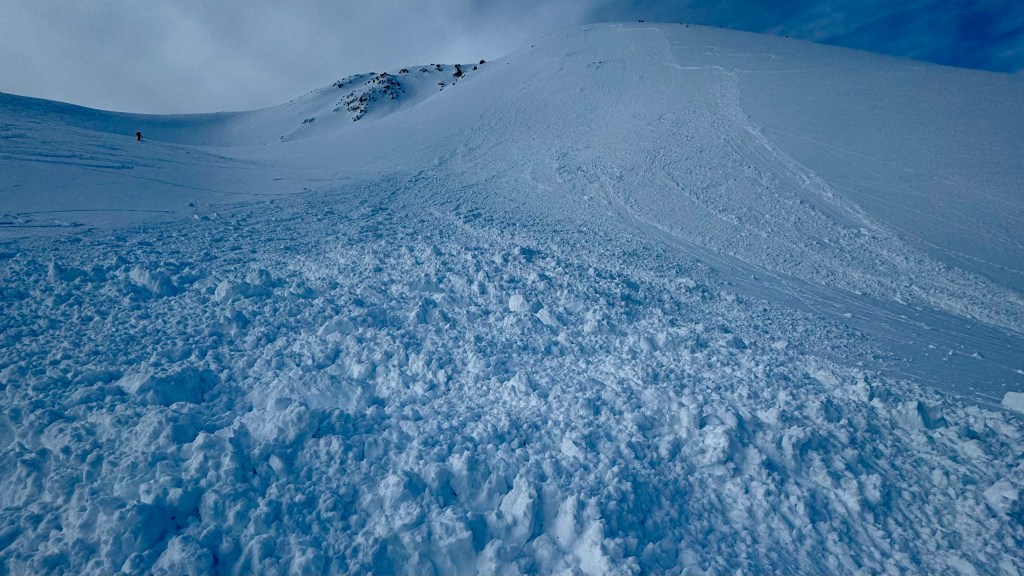
“Did you hear that?” my ski touring buddy asks when the snowpack suddenly settles with a whoompf sound. Seven people in our group already skinned over the same spot. “Yeah, I felt that, too.” “Should we check?”, she asks. I´m nodding excitedly. One quick hand shear test later we get a small block popping out on a smooth surface and 1.5mm large facets. “Wow, I did not expect that!”. Now the others in the group come around checking out what’s going on. We follow up with an ECT. A crack propagates and the whole block pops on 12 taps 40cm deep. “Yeah, but it’s still safe!” exclaims one of our touring partners. Is it though? Or is our touring buddy looking for reasons why it was safe enough to continue the way we planned, reasons that confirm our initial mindset? Does the resistance in changing our approach due to newly discovered evidence tempt us to find explanations why the weaknesses in the snowpack that we just witnessed first hand and that can create avalanches with relatively little additional load could be ignored?
The Take Home Message
What can you do?
- Sticking to just one way of thinking makes it hard to adapt when conditions change or new information comes in.
- Be prepared to switch between different mindsets during the fact-finding, assessment and the justification phases of a tour in avalanche terrain.
- Look for and be open to evidence that contradicts your initial assessment of why something might be “safe enough”.
The process
How can you do this?
- You can do this by having a ‘devil’s advocate’ in the group whose job is to find reasons why the plan might NOT be safe enough.
- Before committing to a line, ask everyone in the group to justify why it is “safe enough” using the collected information.
Go through the following checklist
- Have I thoroughly considered all relevant conditions related to snow, weather, and people?
- What am I not able to assess?
- What am I uncertain about (in the snow, the group, myself)?
- Have we discussed the conditions in the group?
- Have we forgotten anything? (e.g. look for signs of instability in the snow, identifying invisible thought and group processes that might influence our ability to make a high quality judgment)
- Why is it safe enough? Can I justify the quality of my decision process and the result to the ones that care for me and the ones who care for the members of our group if we made a mistake and something goes wrong?
- There is no guarantee that a high quality decision process will lead to the desired result. It simply minimizes (but does not eliminate) the effect luck has on our choices in the mountains.

info box
What´s a mindset?
A mindset refers to a set of attitudes or ways of thinking that shape how a person views and responds to situations. It’s like having a personal filter for how you interpret and react to different aspects of life. For example, if you have a positive mindset, you tend to see opportunities and possibilities even in difficult situations. Conversely, with a negative mindset, you might focus more on the obstacles and challenges.
Think of it as wearing a pair of glasses. Depending on the color of the glasses, what you see changes. Similarly, your mindset affects how you perceive your experiences and can influence your attitudes and behavior.
Asking “Why is it safe enough” increases the quality of the decision-making process.
Really?
Studies by Landrø (2021) and Stephensen et al. (2020) find that people make safer and more conservative decisions when asked to focus on safety instead of just risk. This is explained by the argument that when people ask why it is dangerous and do not see any signs of danger (e.g. because they are not trained to do so) they will automatically assume that it is safe. In wicked environments that do not always provide correct feedback this can have fatal consequences. So, rather than asking “Why is it dangerous?”, they recommend that we ask ourselves and our touring partners “Why is it safe enough?”
I find this research truly inspiring. Like the researchers and practitioners above, I believe in the importance of having solid reasons and justifications for why a particular ski line or objective is safe enough. That’s why I’ve made it a habit to ask, “Why is it safe enough?” This question isn’t just for me; I pose it to my ski buddies, my students, and even avalanche instructors under training during my field work and avalanche courses. Here are some of the responses I’ve gotten:
“Because it was written in the avalanche forecast.”
“The snow feels stable.”
“I have never been asked this question.”
“There are stable conditions now.”
“Yeah, but it’s still safe!” (You recognize this one from the introductory story above.)
All these answers tackle the question “Why is it safe enough?”, or at least why folks think it is. But are these responses really good reasons indicating a high quality decision making process?
The problem: Confirmation bias and motivated reasoning
In my experience, asking “Is it safe enough?” too early can lead us to overlook important details in the fact-finding phase. Especially if we develop an idea (too early in the process, and not based on observations) that something is “safe enough”, it will lead us to look for evidence that supports our hypothesis. This is commonly called confirmation bias. Seeking evidence that only supports our views, while ignoring contrary evidence and diverging perspectives, can lead to motivated reasoning. That is, our motivations (e.g. to ski a certain line, or tick off a certain objective/peak) influence our ability to find relevant reasons why the objective is “safe enough”. We might never actively look for signs indicating why it could be dangerous, and thus never really consider the danger.
If we are never looking for why something might be dangerous, then we always only see the facts we want to see.
info box
Confirmation bias
Imagine you’re a detective in one of those classic mystery stories, but instead of looking at all the clues to figure out whodunit, you decide right from the start that the butler did it. Now, every clue you find, you interpret it as “Ah, this definitely shows the butler is guilty!” even if it’s just a piece of lint in the hallway. You ignore clues that might show the gardener or the chef could be involved. That’s confirmation bias.
Confirmation bias is like having blinders on that keep you only looking in one direction. It’s when you have an idea in your head, and then you subconsciously pay attention only to the information that agrees with your idea and ignore anything that disagrees. It’s like cheering for your favorite team and only seeing the fouls made by the opposing team while missing all the fouls your team is making.
So next time you’re sure about something, remember to take off those “team-colored” glasses and look around; you might find the game is different from what you thought!

The other problem: The need for competence
To assess the quality of the argument why it is safe enough, we need to be competent to assess the conditions ourselves. This demands competence in assessing snowpack dynamics and stability, people dynamics and group processes, as well as individual motivations and goals in a holistic assessment of the situation.
Let me give you a short example; I am a highly motivated reasoner. If I think something is worth doing, I will find a lot of reasons why it is doable, including why it is “safe enough”. Unless you are equally good (or better) in assessing the conditions, it will be easy for me to convince/coerce you that our plan is “safe enough”, even though it is not. This behavior could be the biggest risk to both your safety and mine in the mountains. I admit, without pride, that I have done that many times, both consciously and unconsciously.
Info box
Motivated reasoning
Motivated reasoning is like being your brain’s own defense attorney, always arguing in favor of what you want to believe, even if the evidence doesn’t quite match up. You might ignore facts that don’t fit your case and highlight the ones that do. It’s like insisting your favorite team is the best even when they’re on a losing streak because you’re so loyal to them.
So, next time you catch yourself justifying a shaky opinion, think: “Am I taking into account all the evidence, or am I just rooting for my favourite idea?”
What´s safe enough is a value judgment and will depend on who you ask
I often find myself in situations where a group of skilled skiers, all competent in assessing snow conditions, disagree about when it is ‘safe enough. What I consider safe enough might not seem safe enough to you. This seems to be because ‘safety’ is a value judgment that varies along a spectrum. If you’re getting closer to the absolute extreme of safety on the spectrum, aiming for the highest level of safety and being too cautious, can restrict our actions and conflict with our desire to explore the mountains. Therefore, it becomes challenging to agree on our exact position on this safety spectrum. In these cases, the best approach is often to agree on a common mindset. Please share your thoughts below on how to handle safety judgments that vary among competent people.
What´s safe enough depends on related skills, such as skiing skills
If you’re a skilled skier, you might be able to ski away from avalanches that could otherwise be harmful. So judging the conditions to be safe enough will not only depend on the assessment of snow stability, but also if you think you can handle the consequences if you are wrong and trigger an avalanche.

The solution: Dynamic mindsets
We need to be able to switch between multiple mindsets when assessing, judging and deciding on the conditions and if our plans are “safe enough”. This means that we should ask both questions: “Why could it be dangerous?” AND “Why is it safe enough?” continuously during the whole process of planning and executing a ski touring trip in and around avalanche terrain. Especially during the planning and fact finding-phase (skinning up, assessing snow and conditions) of a ski tour we should look for danger signs, in the snow, the weather, the group or ourselves. It is important that we are open to evidence that contradicts our motivation, plans and initial assessment. Continuously asking “Why is it NOT safe enough, and why IS it safe enough?” will ensure that we have collected the information we need to argue and justify either the one or the other.
We should aim to participate in groups that can help and support each other in asking these questions and that aspire to make shared decisions through open communication.

Motivation (and its underlying processes) affecting our behavior seems to hold true for other safety behaviors, too. Let me finish with a little anecdote one of my co-researchers told me on a ski tour.
“I have this friend who forgot his beacon on one of our tours. When the group wanted to do a beacon check, he was arguing to do it later, on a flat part once we got a bit further up the mountain. Presumably to coerce the group into not doing it and not discovering that he had forgotten his beacon.”
So was it safe enough?
You might wonder what happened to our group from the short story above and whether the conditions were safe enough. Well, after the positive ECT result (which was bad news for skiing steep lines) we cranked down our offensive mindset two notches and reassessed the situation. To our best abilities we judged the situation to still be quite safe, i.e. safe enough, in general, and that the positive ECT result was mainly due to a local hot spot where the weak layer was active. When we continued probing the snowpack making our way to the peak, both facets became smaller and the bed surface much less smooth so no cracks could propagate.
One final thought
I wholeheartedly agree that as human beings we have to be able to say “this is safe enough”, and “this is good enough”, both in snow covered mountains as in everyday life. Using high quality arguments supporting why something is doable and “safe enough” given the current conditions, are important for justifying our decision making process. I practice it myself with my tour buddies and I challenge my students at both recreational and pro avalanche courses to ask this question in order to increase the quality of our decision making process. But overemphasizing the question “Is it safe enough?” during the planning and fact finding phases of a ski tour is simply not good enough. It cannot ensure that we have made the best decision possible and that I can justify the quality of my decision process and result to the ones that care for me and the members of our group if we made a mistake and something goes wrong. The tricky part about motivational reasoning and confirmation biases is that we often don’t notice when they sneak up and trip us up. Perhaps our touring buddies can notice, though?
 The Avalanche Philosopher