… and why safety in avalanche terrain is about more than not getting caught.
In the avalanche world, ‘safe’ usually means one thing: not caught, not buried, not killed. What if this understanding is too narrow? What if safety is also about being safe to speak, and safe to learn?
Part 1 of 3 on ‘safety’ in avalanche terrain.
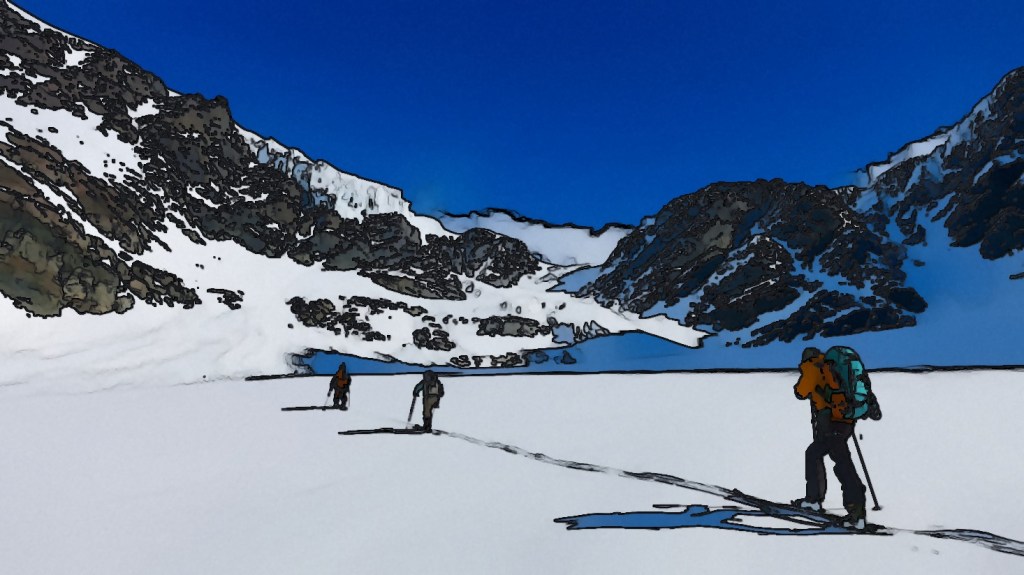
Bluebird day. The most difficult hazards to manage may not be in the snow.
Bluebird day, two days after a storm. Five of us skin up towards a northeast-facing bowl we’ve all skied before. Halfway up, the snow settles under Magnus’ skis with a soft whoomph. He stops for a second and looks around. Nobody else seems to have noticed. Or if they have, nobody says anything. The two strongest skiers in the group are already talking lines.
At the top, we dig a quick pit. The tests look okay-ish. “Looks good,” someone says. “Same as last week.” Magnus is the newest in our group. He pulls his goggles down and doesn’t say a word. We drop in, one at a time: cold, deep, perfect snow. Whoops and high-fives at the bottom.
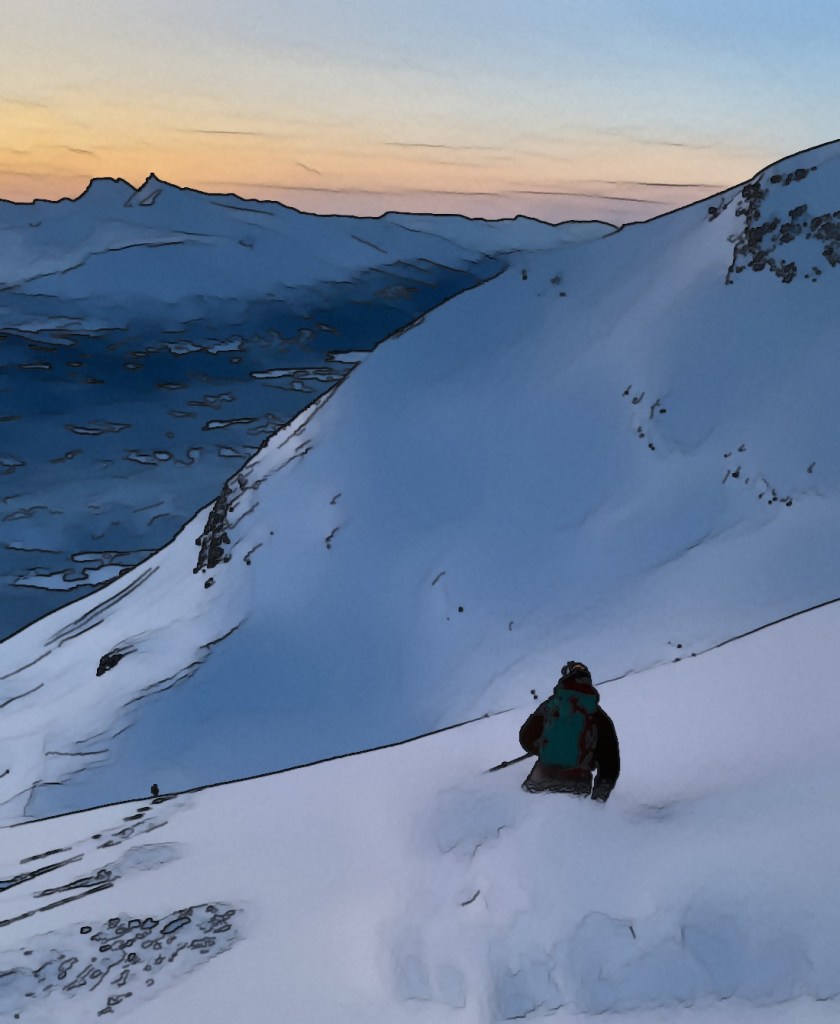
One at a time: cold, deep, perfect snow. High-fives at the bottom.
It’s only in the car on the way home that he brings it up. “Did anyone else feel that whoomph on the way up?” Silence. Then: “Why didn’t you say anything?” He shrugs. “Everyone seemed so sure. And I didn’t want to be the one who ruined the day.”
Was it safe? We skied the slope and nothing happened, so in the narrow sense: yes. But one person in the group had information that could have changed the decision, and the group gave him no easy way to share it. And the most important learning moment of the day almost didn’t happen either. It came in the car, more by chance, two hours too late.
That story is a composite, stitched together from tours I’ve been on and stories touring partners have told me. But I suspect you’ve been on a version of it, too. Maybe as Magnus, maybe as one of the people talking lines.
Most of what we teach and research in avalanche safety is about the first half of that story: the pit, the tests, the snow. Very little is about the second half: the whoomph nobody mentioned, and whether there was room for it in the group.
Those who have read the blog know I have a soft spot for one question: why is it safe enough? In my last post I argued that since the mountain doesn’t always answer back, the honest feedback has to come from our peers. This post asks the uncomfortable follow-up: what if our peers don’t feel safe enough to give it?
My short answer: we need a wider understanding of safety and risk, one that includes the people on the slope, not just the snow under their skis.
A useful question
This autumn we published a study (Dassler, Fjellaksel & Pfuhl, 2026) in which we followed ten skiers through a season-long avalanche course. After each tour, we asked them about the most critical slope of the day: why did you decide it was safe to go? We then scored their answers against the Systematic Snow-Cover Analysis. Did they identify the weak layer? Did they assess whether a crack would start and spread? Did they connect what they found in the pit to the slope they wanted to ski?
The question worked. Better than we’d hoped, actually. On a scale from 0 to 1, the average score jumped from 0.25 at baseline to 0.85 after the core modules. A year later, it had fallen right back to 0.25. Sobering, if you believe a single course, or a whole season of learning, does the job.
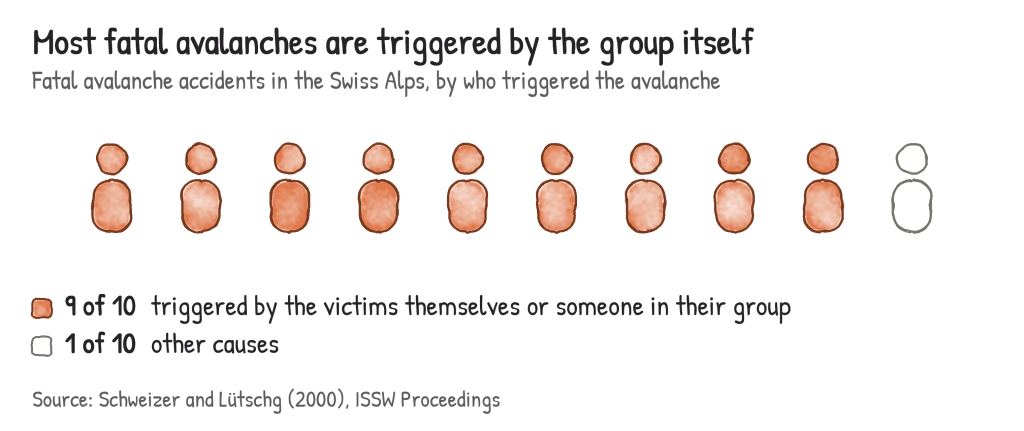
I still think it’s a useful question to ask: of your touring partners, of yourself, or, if you’re an avalanche instructor, of your course participants. But framing safety as something that’s only about the snow can pull our attention away from what may matter most. In about nine out of ten fatal avalanche accidents the avalanche is triggered by the victims themselves or by someone in their own group (Schweizer & Lütschg, 2000). And again and again, I hear the same story afterwards: someone had a bad feeling, noticed a warning sign or felt uncomfortable, but didn’t say so. And then the avalanche hit.
Rachel Reimer’s work helped me see what our question, and the way we framed it, couldn’t.
What our scoring couldn’t see
Here are two of the answers we got:
“… Most importantly, members of the group—some of whom were familiar with the specific slope—expressed confidence that it was safe to ski.”
“That was the slope the group descended.”
The first one scored 0.5 (mainly trusts the judgement of others). The second scored 0 (just followed the group). As a measure of snowpack reasoning, those scores are fair. But read the answers again. Both are, first and foremost, about the group. And in our rubric, the group only ever showed up as an absence: a sign that snow knowledge was missing.
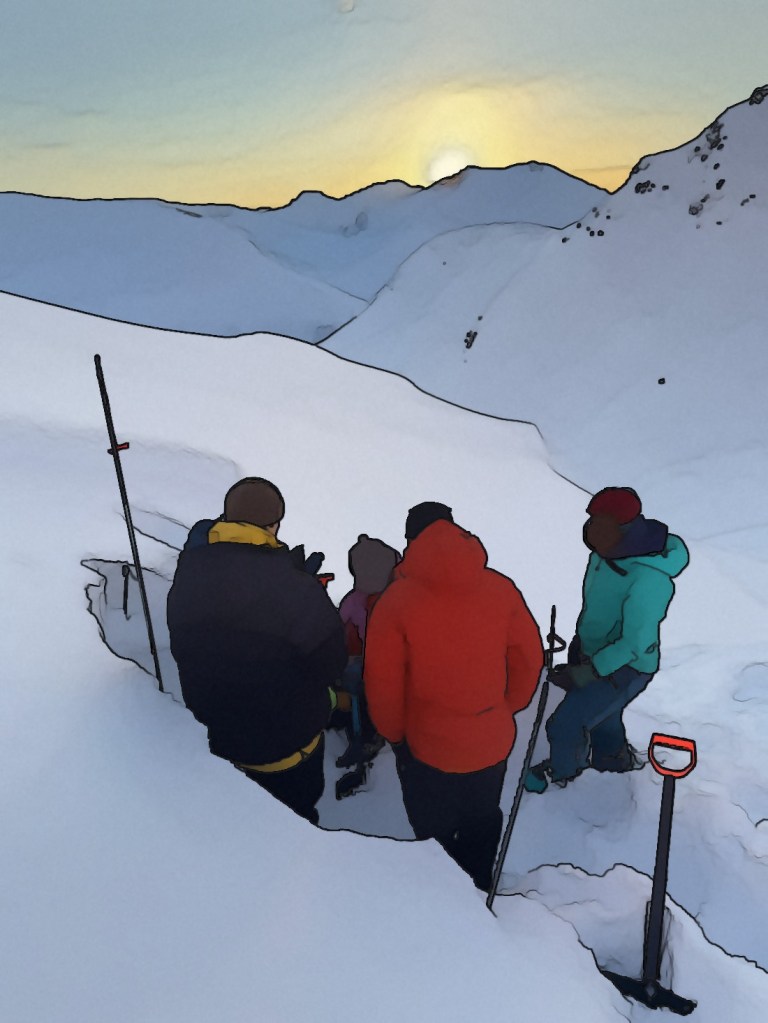
The pit gets everyone’s attention. Who’s standing at the edge?
We never asked the obvious follow-up: what was it like to be in that group? Was there room to say I’m not sure? Our course had eight men and two women. Did that shape who spoke up, and who was listened to? We don’t know, because we didn’t ask.
And here’s a detail that stings a little to admit. In our discussion section, we listed five possible explanations for why the learning faded. Number five was “other factors such as group dynamics.” The first four each got a section of their own. Number five never made it into the published paper.
Feeling safe enough
Reimer and her colleagues (Reimer & Eriksen, 2025; Reimer, Eriksen & Warren, 2026) interviewed 17 mountain guides and avalanche professionals in Canada, the USA, France and Switzerland. All of them identified as women, 2SLGBTQ+, BIPOC or survivors of workplace trauma, in a profession that remains overwhelmingly White, cis-gender and male. What they describe is a kind of risk management most of us never have to think about.
Participants defined psychological safety as feeling safe enough to show your full self, and to speak up when something feels unsafe, whether the threat comes from the mountain or from the people around you. Eight of the 17 drew a straight line from psychological safety to physical safety:
“Most accidents you can trace back to some … psychologically unsafe environment.”
They also describe what speaking up costs. Participants rationed their objections, asking themselves how bad things had to get before they said anything. Some routed their concerns through male colleagues, just to be taken seriously. One described the energy it takes to keep up a facade as a hazard in itself, because it drains attention from the things that could actually kill you.
Reimer and colleagues call this the second shift of risk management: handling exclusion, harassment and discrimination on top of the snow, every day, often in silence. Working that second shift, it turns out, forces you to think about risk in a much wider way than most avalanche courses teach.
Stretching the words we already use
Here’s what struck me most. Reimer’s participants didn’t invent a new vocabulary for risk. They used the one every avalanche course teaches, the hazard, exposure and vulnerability. They simply refused to stop at the snow.
Hazards aren’t only avalanches, rockfall and cornices. They include exclusion, harassment, discrimination and the stigma around mental health. Reimer and colleagues call these human-caused hazards. They are every bit as real as a weak layer, and unlike a weak layer, they are entirely the result of human choices.
Exposure isn’t only the minutes you spend in a release or runout area. For the guides and avalanche professionals Reimer interviewed, it’s the evening in the hut with a guest who has made his views on your identity very clear. It’s the closed-door meeting where a supervisor asks whether you’re planning to have children. It’s a whole career of small judgements about when it’s worth speaking up. For recreational skiers, it can look different but feel familiar: being the newcomer in a crew that skis rad lines, and spending the whole trip, from the trailhead to the drive home, trying to prove you belong. Either way, the second shift doesn’t end when you take off your skis.
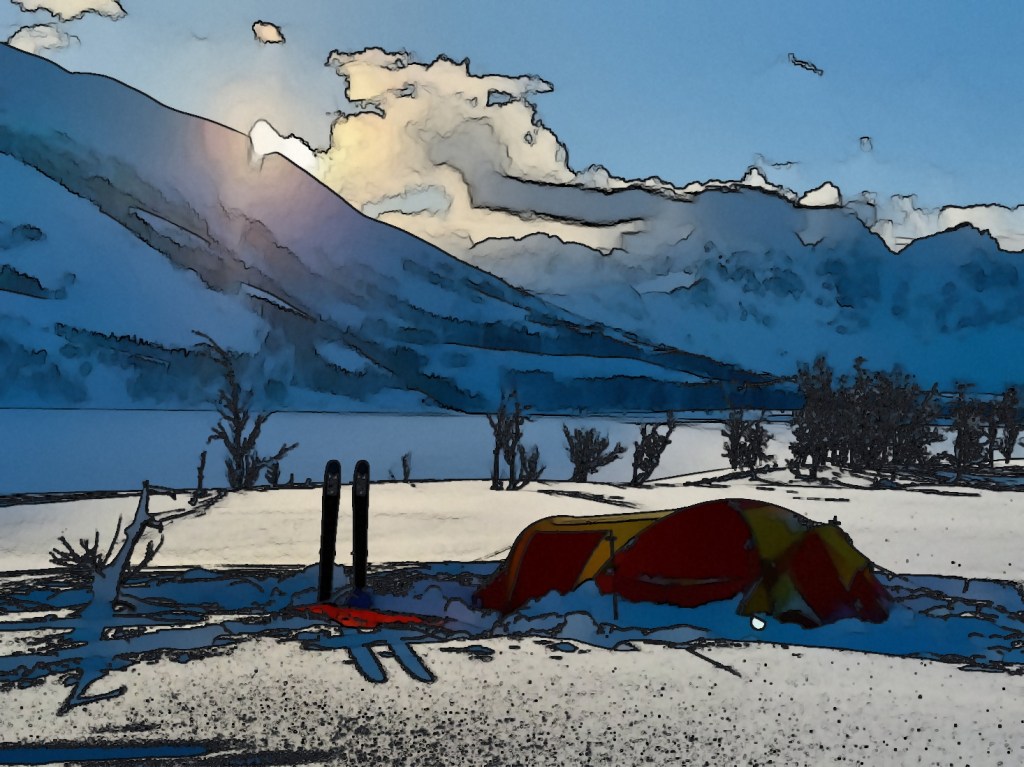
For some, the hardest part of the trip starts after the skiing.
Vulnerability isn’t only how susceptible you are to being hurt by an avalanche. It’s also the willingness to say I’m not sure, I’m scared or I got that wrong. Strikingly, participants saw that second kind of vulnerability as a way of reducing the first: “We can’t reduce vulnerability in the mountains unless we’re willing to be vulnerable ourselves.”
Put together, Reimer and colleagues call this intersectional risk: a function of mountain hazards and human-caused hazards, exposure and vulnerability. It doesn’t replace the avalanche risk we already assess. It’s the same picture, with the frame pulled back far enough to include the people in it.
To be fair, the formal definition was wide all along. The risk standard behind most avalanche training materials, ISO 31000, defines risk as the effect of uncertainty on objectives. Nothing in that sentence says only the snow. We narrowed it ourselves, in research, in framing, in practice.
Three kinds of safety
If risk is wider, safety has to be, too. Reading our own work alongside Reimer’s, I’ve started to think of safety as (at least) three things that depend on each other:
- Safe from the mountain: not caught, not buried, not killed. The kind of safety we already teach and research.
- Safe to speak: being able to say what you see and feel, including no, while the decision is still open, and without paying for it afterwards.
- Safe to learn: being able to admit what you don’t know, make mistakes on easy days, and debrief honestly, the good days included.
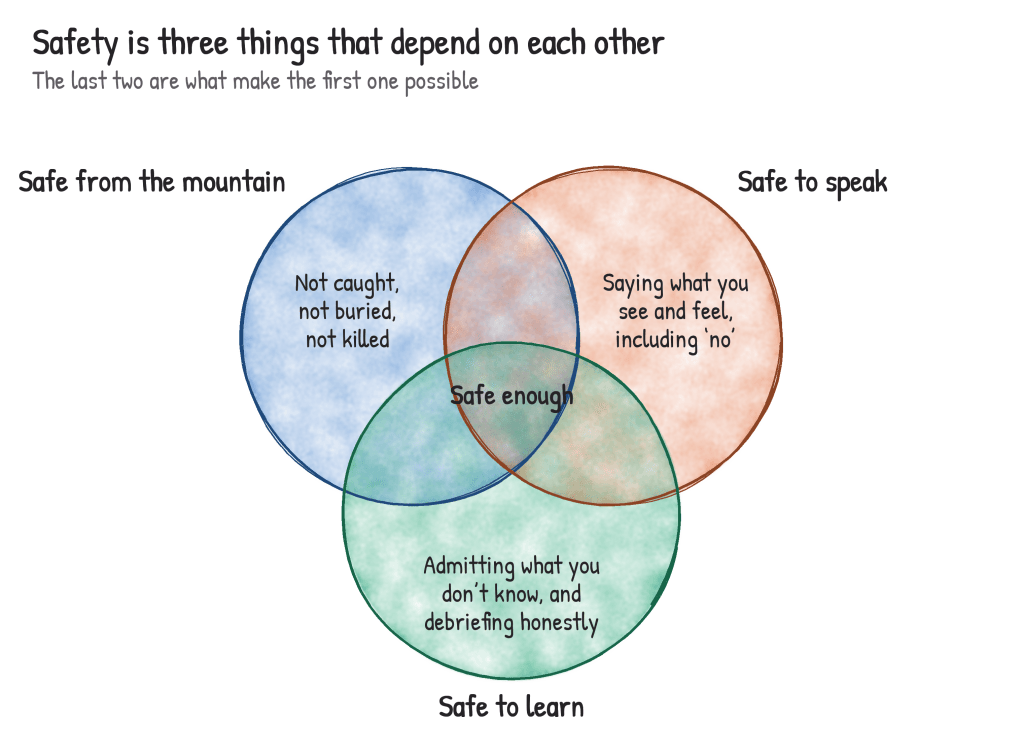
Each circle on its own is a narrow kind of safety. Where all three overlap is what I’d call safe enough.
Think back to Magnus’ tour. The group got lucky on the first, failed on the second, and only stumbled into the third on the drive home.
The last two are what make the first one possible. Reimer’s participants described physical safety as both something that supports psychological safety and something that grows out of it. In our own course, the participants who reported the most learning moments were also the ones who asked for the most help, something that’s far easier in a group where admitting you don’t know feels safe. And on a mountain that doesn’t always answer back, honest feedback from our peers is the only feedback we can count on. It only flows where it’s safe to give.
That is why my colleagues and I argue that avalanche education still runs mostly on what safety scientists call a Safety-I logic: identify hazards, apply rules, avoid failure. Wicked environments also need Safety-II: safety not as the absence of accidents, but as something a group keeps achieving, day after day, through attention, judgement, adaptation and mentored learning (Dassler & Dahl, 2026). That, in a sentence, is the wider safety this post is arguing for.
Why the snow is such a comfortable place to look
So why do we keep reducing safety back down to the assessment of snowpack stability? Part of the answer might be that the narrow version quietly decides where we look for problems, and therefore where we look for solutions. If safety is only about the snow, the fix is always more snow knowledge: better tests, better profiles, better courses.
We built our study on exactly that logic, and we’d do much of it again. But here’s the thing: a perfect snow profile is worth little if the person who dug it doesn’t feel able to say I’m not comfortable with this. Our question asked whether people could reason about the snowpack. It never asked whether their reasoning had any chance of changing what the group actually did.
There’s an uncomfortable honesty point here, too. Talking about facets and shear quality is easier than talking about who gets listened to, and who doesn’t. Snow science gives us a shared, neutral-sounding language, and that’s part of its value. But it can also become a place to hide from questions about ourselves.
To be fair, the human factors literature hasn’t ignored groups. McCammon’s FACETS includes acceptance, communication and the expert halo. But these tend to be framed as individual errors to correct, not as properties of a group climate that someone has to actively build. And when Reimer and colleagues reviewed that literature, they found it almost never considers group make-up or unequal power.
A few honest caveats
I don’t want to swap one oversimplification for another, so let me be clear about what I’m not claiming.
Reimer’s participants were professionals from non-dominant groups. Ours were recreational skiers on a course, mostly men. Peer pressure among friends on a weekend tour isn’t the same as the hierarchy between guides, clients and examiners. The mechanisms may overlap; the stakes and power structures differ.
The link between psychological safety and accidents is, so far, drawn from participants’ experience rather than measured. Reimer and Eriksen say so themselves, and call for research that measures it. It’s tempting to claim that feeling safe to speak up would prevent most human-triggered avalanches. I find that plausible, but it deserves to be tested, not asserted.
And none of this makes snow knowledge less important. Speaking up only helps if someone has noticed something worth saying. Psychological safety and snowpack assessment aren’t rivals; each is close to useless without the other.
What this means in practice
If safety means being safe from the avalanche, safe to speak and safe to learn, then the path forward isn’t only more snow science. It’s building the conditions in which what people notice can actually be said, and heard. A few concrete implications follow.
For us as researchers, ‘Why is it safe to go?’ needs a twin: did you have any doubts you didn’t voice? Asked anonymously, and asked again in the field. We should ask who in the group could have turned it around, and how that would have been received. We could treat “I trusted the group” as data about the group, not only as a gap in the individual. And we could analyze the group dynamics data we already collect, while protecting the few participants who differ from the majority and could easily be identified.
For all of us as touring partners, it starts at the trailhead (probably before). Ask what would make each person want to change plans or turn around today, and agree that saying so is enough. Make ‘no’ easy: one voice should be able to stop the group without having to win an argument. And notice who hasn’t said anything yet, and ask them. Magnus would have told you about the whoomph.
One final thought
I still think why is it safe to go? is a good question. It shows how well someone can connect the snowpack to a decision, and it costs nothing to ask during a course or on any tour. I’ll keep asking it.
But safety isn’t only a property of the snowpack. It’s also a property of the group about to enter potentially dangerous terrain, and of the learning environment we build around it. Risk, likewise, is never only in unstable snow. Interestingly, two lines of research landed on the same word: Landrø’s PhD thesis asked why it is safe enough, and Reimer’s participants talked about feeling safe enough to speak. Residual risk never disappears, not on the mountain and not in the group.
So maybe my favorite question needs a twin. Before anyone in your group asks why is it safe to go?, ask yourself, and your buddies, something else: is it safe to say no?
Thanks to Tove Irene Dahl and Tarjei Westerlund for sharp and generous feedback, and to the inspiring people I met at ISSW in Whistler, whose conversations planted many of the ideas in this series.

