Why steep skiing isn’t really about risk, why we may need to rethink the way we understand this activity, and what that means when things go wrong.
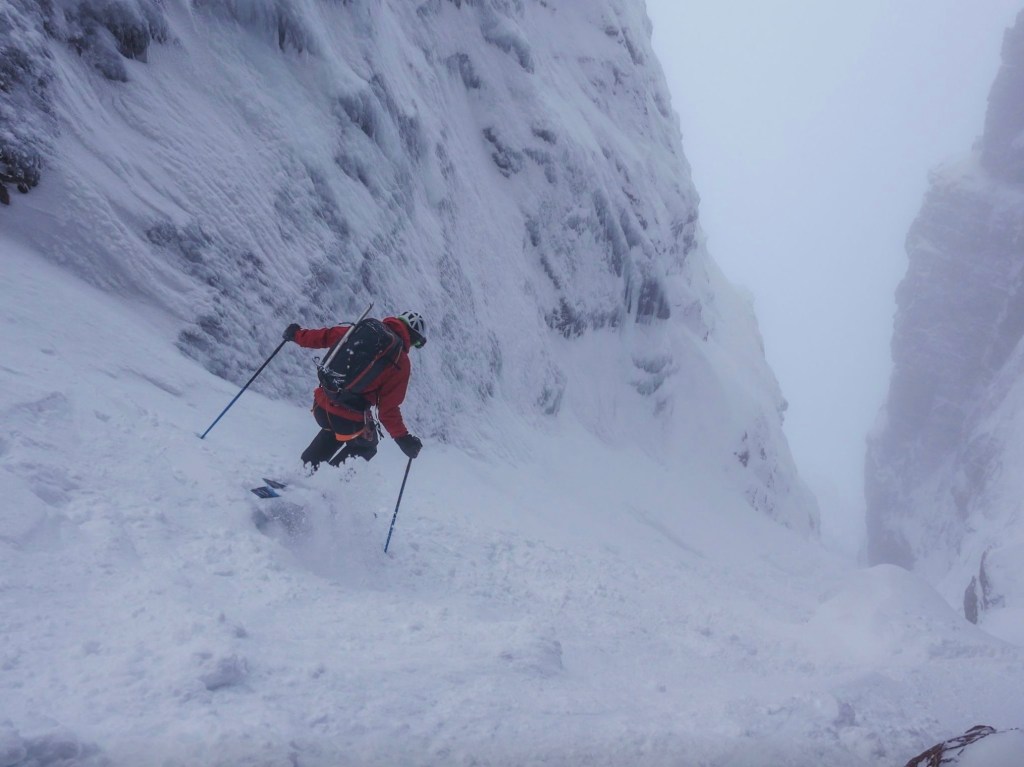
Ask someone who has never done it why people ski steep couloirs, and you’ll usually get some version of the same answer: they’re adrenaline junkies. They want to pursue risk. Something in them needs the danger.
We’ve now interviewed twenty-two experienced steep couloir riders; guides, forecasters, professional freeride athletes, lifelong recreational practitioners. We’ve asked them directly what draws them to this. Almost nobody talked about risk. They talked about “aesthetic and beautiful” lines. About skiing that feels “as close to flying as you can get.” About snow as something you read and answer, not something you beat. And, again and again, about waiting: you don’t choose a line and go ski it. You watch it for a season, sometimes for years, and wait for the mountain to grant it.
That last phrase is worth sitting with, because it quietly dismantles the risk-seeking narrative. Risk is something you can grab any day of the winter. An encounter is not.
A relationship, not a thrill
The German sociologist Hartmut Rosa has a word for what these riders are describing: resonance — a relationship in which the world isn’t a mute backdrop or a resource, but something that addresses you and that you answer back. His sharpest claim is about what makes such a relationship possible: the other side has to be uncontrollable. Because something fully available on demand, something schedulable, guaranteed, conquerable, will eventually go silent. What moves us is precisely what we cannot command. Nature. And a steep snow-filled line.
Steep riding is almost a laboratory case. The line cannot be summoned. The mountain, the snow decides. And here is the apparent paradox: nobody controls more than these practitioners. They plan, assess conditions, dig pits, run stability tests, debrief, train, rehearse rescue. If they were trying to eliminate uncertainty, this would make sense, but then the thing they came for would die. The control isn’t there to conquer the mountain. It’s there to let them survive staying in relationship with something that can never be made safe. Mastery in the service of contact, not control, never domination.
This also explains something the riders themselves point to: the difference between someone skiing a line because it calls to them, and someone skiing it for the photo, the clout, the tick. Same couloir, opposite relationships. One is a conversation, the other is a trophy hunt where the mountain has already gone mute. As one rider put it; “are you here because you’re curious, or because you want to be cool?” Practitioners can feel the difference from inside. Many of them think it’s also the difference that gets people hurt.
The shadow side
But if the fascination lives in the mountain’s uncontrollability, then we have to be honest about what else lives there. The same property that makes the relationship resonant is the one that kills, buries, and bereaves. Trauma is not an outside intrusion on this activity. It is the shadow of the very thing that draws people in.
One elite athlete in the study said something that should change how the community talks about this: “you don’t need to be buried or injured to be traumatised.” Being close to an avalanche is enough. Witnessing one is enough. “Digging someone out” is enough. And because so many people assume trauma requires a body count; “I didn’t die, I wasn’t hurt, I was just the one rescuing”, they never recognise what happened to them, and never get help.
In Rosa’s terms, what trauma does is brutal and precise: it converts resonance into alienation. The mountain that called goes silent, or hostile. The snow that answered back falls quiet. Riders describe being unable to make decisions in terrain where decision-making was once fluent: the relationship itself has been ruptured, not just the confidence.
And the rupture gets silenced twice over. From outside, the activity is stigmatised as reckless; “you chose this”, which withholds the sympathy that would make help-seeking legitimate. From inside, a culture that prizes boldness makes admitting trauma feel like a demotion. So, the most predictable injury in the sport stays the least discussed.
Repair is social
Here’s the hopeful part: in the accounts we heard, recovery looks like the slow rebuilding of the same relationship. And it happens socially. The athlete who spoke most openly about their PTSD returned to the mountains only with people they trusted, telling them explicitly: “I cannot make decisions right now; you have to.” They rebuilt their confidence by teaching, reminding themselves how much they actually knew. They gave it time. And their rule? “If you can’t communicate your state, stay out of the mountains until you can.”
That’s not a clinical protocol. It’s a community practice, and it points to what the reframing is ultimately for. If we keep telling the risk-seeking story, trauma looks like the foreseeable bill for a selfish habit, and silence is made reasonable. But if this is, at its best, a demanding relationship with a world that cannot be made available, then trauma is a rupture in that relationship, recovery is its repair, and the community around the rider is where that repair happens. We should talk about it that way: openly, without the morally high-horsed finger raised, saying “you chose this“. And we should address this with the same attention we give beacons and rescue drills.
The mountain answers back, that’s the whole draw. Sometimes the answer is devastating, and the people who receive it deserve better than silence.
——
You can read more about the project at intothesteep.com. And if you have a story of your own to share, We’d love to hear from you.
 The Avalanche Philosopher
Leave a comment